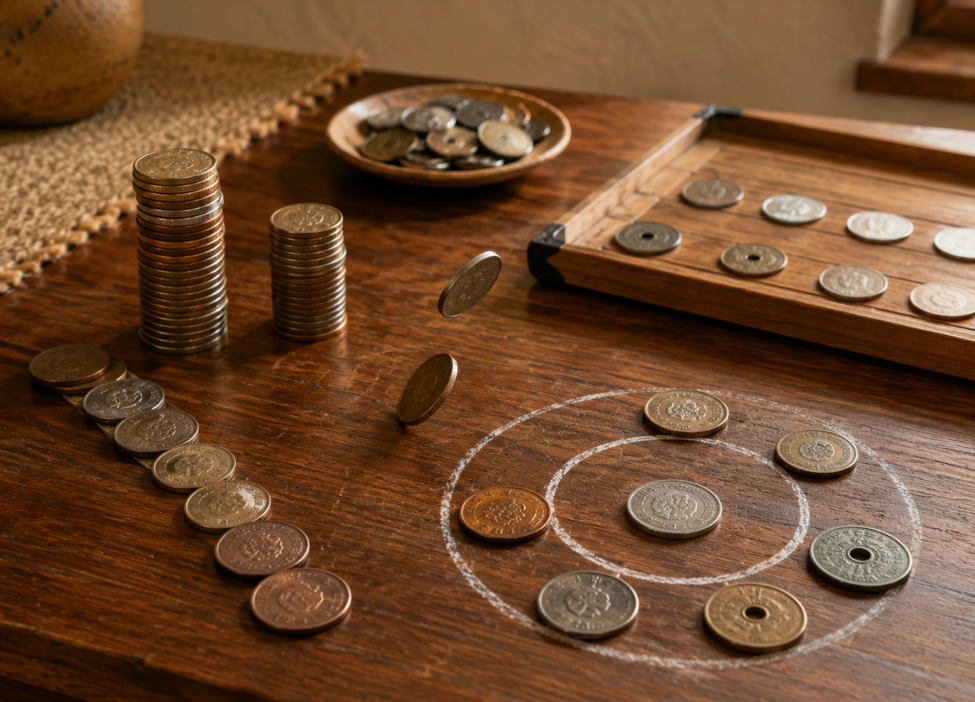
The image was created by us with AI, specifically for this article.
A pile of old coins is already a game set. You have pieces with different sizes, weights, edges, dates, and designs. That gives you more variety than plain plastic tokens, and you do not need to buy anything extra to start playing. The trick is choosing games that actually use those differences instead of treating the coins as generic markers.
The best home coin games do one of three things well. They turn coins into stakes, they turn coins into physical objects you can aim or sort, or they turn coins into hidden information. That is why dice games, pitching games, and bidding games work better than most simple counting games. Each one gives the coins a clear job.
Below are three games worth playing whenever you are not in a mood for Wordle or other puzzle games. Each section sticks to one game and explains how to make old coins matter in the rules, not just in the setup.
Craps With Old Coins
If you want one game where old coins can do a lot, play craps.
You only need two dice. The coins can serve as chips, point markers, side bets, and score counters.
The basic idea is simple. On the first roll:
- 7 or 11 wins
- 2, 3, or 12 loses
- any other number becomes the point
After that, the shooter keeps rolling. The goal is to roll the point again before rolling a 7.
Now these are the essentials of craps rules for beginners, and they give the fundamental information needed to have an overall picture of the game. But if you have more knowledge about craps, feel free to explore further tactics, game developments, and so on. The idea of this piece is not to go deep into the rules, but to give you some hints on how to use the old coins in craps, because they also make the betting cleaner, and simple gameplay is what many people want.

Original visual material, specifically created for this article.
Small coins can be one-unit bets. Larger or older coins can be worth five units. A good home version keeps the options narrow. Start with a pass bet, then allow an extra odds bet only after the point is set. That keeps the table readable and cuts out clutter. It also gives the game a sharper rhythm, because the first decision is simple and the second decision comes only when the round has shape.
There is also a simple strategy here. On two dice, 7 is the most common number. It can happen in 6 out of 36 possible rolls. That means a home version of craps should not use too many side bets that depend on rare numbers. Those can make the game harder to follow.
Other numbers show up less often:
- 5 appears in 4 out of 36 rolls
- 6 appears in 5 out of 36 rolls
- 8 appears in 5 out of 36 rolls
This does not mean players can “solve” craps. Luck still matters. But it does make the game easier to manage when everyone understands which numbers are more common, on top of the gaming strategies you may want to obtain:
Old coins improve the game because they make every wager visible. A silver coin can mark a main bet. A copper coin can mark odds. A large foreign coin can mark the point. Subsequently, the game moves fast, but the table still stays easy to read.
Coin Pitch Into Cups
If you want something skill-based instead of dice-based, coin pitch is the cleanest option. Set out three cups or bowls at different distances. Give each player the same number of old coins. Then score the round by where the coins land. Near cup, one point. Middle cup, two. Far cup, three. If you want more tension, require the coin to stay in the cup after the bounce.
| Coin | Diameter | Weight | What it does in coin pitch |
| Penny | 19.05 mm | 2.50 g | Easy to carry, can bounce more |
| Nickel | 21.21 mm | 5.00 g | Stable flight, solid landing |
| Dime | 17.91 mm | 2.268 g | Small target profile, quick release |
| Quarter | 24.26 mm | 5.67 g | Heavy feel, easier to judge in the air |
That is why mixed old coins make the game better than identical tokens. Players have to decide whether they want control, weight, or a smaller shape. You can also build rounds around the coins themselves. One round can allow only the heaviest coins. Another can reward exact landing in a small cup. Another can give bonus points if the coin date matches a number called out before the throw.
Coin pitch is easy to set up, but it still gives players real choices. That is enough to keep it interesting for more than one round.
Blind Coin Auction
Blind Coin Auction is a good choice if you want a quieter game where players try to read each other.
Each player starts with the same number of old coins. For each round, put a small prize in the middle of the table. The prize can be something simple, like:
- first choice of dessert,
- control of the next song playlist,
- or a bonus card like “double your next bid.”
After three or five rounds, the player with the best prizes or the most points wins.
In this game coins are perfect hidden information. Their sound, weight, and feel create pressure before anyone opens a hand. A large coin can bluff strength. A handful of small coins can sound bigger than the bid really is. That physical tension is a big part of the appeal of tabletop play in general. A 2025 market forecast projected that the tabletop games market will grow by $4.76 billion from 2024 to 2029, with a 12.3% compound annual growth rate.
The social side matters too. As Jane McGonigal said, “Playing a game together actually builds up bonds and trust and cooperation. We actually build stronger social relationships as a result.” That fits Blind Coin Auction especially well, because the game is built around reading people, not just counting pieces.
Old coins make the auction better because they make every bid feel real. Plastic counters do the math, but coins create sound, weight, and hesitation. That is exactly what a bidding game needs.